Key Takeaways:
- Average height is a guide, not a goal. The average height of a 4-year-old girl is 40 inches (50th percentile), but healthy growth spans the 3rd to 97th percentile, consistent tracking over time matters far more than any single number.
- Multiple factors shape your child's height. Genetics, nutrition, sleep, and overall health all influence how a 4-year-old girl grows, making it important to support her development holistically rather than focus solely on measurements.
- Home tracking builds memories and peace of mind. Measuring your daughter regularly with a dedicated growth chart helps you spot patterns early and creates a cherished record of childhood milestones that door-frame marks simply can't preserve.
When was the last time you marked your daughter's height and felt that quiet rush of "When did she get so tall?" or wondered whether she should be taller by now? As parents, we watch our children grow every single day, yet somehow it still catches us off guard when a favorite dress suddenly becomes a shirt or when she can finally reach the bathroom sink on her own.
At Headwaters Studio, we've spent years helping families turn these fleeting moments into lasting memories. Through our handcrafted growth charts made from premium maple plywood, we've witnessed thousands of parents mark not just inches, but milestones, first days of school, growth spurts after summer, quiet Tuesdays that become unexpectedly meaningful.
In this piece, we'll walk you through what's considered the average height of a 4-year-old girl, how to read growth charts without the medical jargon, what factors influence your daughter's growth, when variations signal a real concern, and how to track these precious milestones at home in ways that become part of your family's story.
What Is The Average Height Of A 4 Year Old Girl?
The average height of a 4-year-old girl in the United States is about 40 inches, or just over 3 feet 3 inches. This measurement corresponds to the 50th percentile on CDC growth charts, meaning that half of 4-year-old girls are taller and half are shorter. But here's what really matters: "average" doesn't mean "ideal." On CDC growth charts, many clinicians consider the 3rd to 97th percentiles to be a typical reference range, with exact heights varying by age. A difference of several inches is perfectly typical.
Your daughter's height at 4 reflects a combination of genetics, nutrition, health, and her individual growth timeline. Some girls grow steadily throughout the year. Others have growth spurts that happen overnight, followed by slower periods. Both patterns are normal. What pediatricians focus on isn't whether your child is "average," it's whether she's growing consistently along her own curve over time. A girl who's been in the 25th percentile since birth and continues tracking that line is just as healthy as one who's been in the 75th percentile all along.

What To Expect At 4½: Is Your Daughter's Height On Track?
By the time your daughter reaches 4½ years old, you can expect her to have grown about 1 to 1½ inches since her fourth birthday. This steady, incremental growth is typical for preschool-aged children, who generally add roughly 2 to 3 inches per year during this stage, with normal variation by age and individual pattern.
How Much Should a 4-Year-Old Girl Grow in Six Months?
Most 4-year-old girls grow approximately ½ to 1½ inches over a six-month period. Growth isn't always linear; your daughter might gain more height during one six-month stretch and less during another. Seasonal patterns, illness, and individual biology all play a role.
Does Growth Speed Change After Age 4?
Growth rates naturally slow down after the rapid infant and toddler years. By age 4, your daughter is in what's called the "steady growth phase," which continues until puberty. During this time, expect consistent but gradual height increases rather than dramatic spurts.
What If My Daughter Hasn't Grown Much Since Her Last Checkup?
If your daughter seems to have grown very little or not at all over several months, it's worth noting but not necessarily cause for alarm. Growth can temporarily plateau, especially after illness or during periods of significant physical or emotional change. However, if you notice a consistent lack of growth over 6 to 12 months, mention it to your pediatrician.
A Parent's Plain-English Guide
Growth charts can feel intimidating, but they're simply tools that show how your daughter's height compares with that of thousands of other girls her age. Understanding them takes the mystery, and often the worry, out of the numbers.
What Do Percentiles Actually Mean?
Percentiles tell you what percentage of children are shorter than your daughter. If she's in the 60th percentile for height, it means she's taller than 60% of girls her age and shorter than 40%. Percentiles don't measure health; they measure comparison. A girl in the 10th percentile can be just as healthy as one in the 90th.
Which Growth Chart Should You Use?
Most pediatricians in the U.S. use CDC growth charts for children aged 2 and older. These charts are based on data from a large, diverse population of American children. The World Health Organization (WHO) also provides growth charts, often used for younger children. Ask your pediatrician which one they use to ensure consistency.
What's More Important Than the Number Itself?
The pattern over time matters far more than a single percentile. Pediatricians look for consistent growth along a predictable curve. A child who steadily tracks the 20th percentile year after year is healthy. A child whose percentile suddenly drops or spikes, especially across multiple appointments, may need further evaluation.
Can You Track Growth at Home?
Yes. Measuring your daughter at home between checkups helps you see progress in real time. Use a flat wall (not carpet or baseboards), have her stand barefoot with heels, back, and head touching the wall, and mark the spot. Recording these measurements on a dedicated growth chart turns data into a visual story your family can revisit for years.

What Really Drives Your 4-Year-Old Girl's Height?
Height isn't random. It's shaped by a combination of factors, some within your control and many that aren't. Understanding what influences growth can help you support your daughter's health without unnecessary worry.
Genetics: The Blueprint
Genetics strongly influences a child's height. If both parents are shorter, their daughter is more likely to be shorter. If both are tall, she'll likely follow suit. However, height genes are complex; children don't always land exactly in the middle of their parents' heights.
Nutrition: Fuel for Growth
Adequate nutrition supports healthy growth, but it doesn't override genetics. A balanced diet with enough protein, calcium, vitamins, and healthy fats gives your daughter's body the building blocks it needs. Chronic malnutrition can stunt growth, but extra food or supplements won't make a genetically shorter child taller.
Sleep: When Growth Happens
Adequate sleep is essential for healthy development. Preschoolers generally need substantial sleep for optimal growth and overall health. Consistent sleep routines support both physical growth and development.
Health Conditions
Chronic illnesses, hormonal imbalances, or genetic conditions can affect growth. Conditions like growth hormone deficiency, thyroid disorders, or celiac disease may slow height gain. If your pediatrician suspects an underlying issue, they'll recommend appropriate testing and treatment.
Does Activity Level Affect Height?
Physical activity promotes bone health and overall development, but it doesn't directly make children taller. Active kids tend to be healthier, which supports normal growth, but exercise won't add inches beyond genetic potential.
How To Track Your Girl's Growth At Home
Tracking height at home isn't just about medical monitoring; it's about creating a visual timeline of childhood. These measurements become memories, stories, and eventually, heirlooms.
How to Measure Accurately
Use a flat, uncarpeted wall. Have your daughter stand barefoot with her back, heels, and head touching the wall. Use a flat object (like a book) placed on top of her head, parallel to the floor, and mark the spot with a pencil. Measure from the floor to the mark.
How Often Should You Measure?
Measuring every few months strikes a balance between tracking progress and avoiding obsession. Birthdays, half-birthdays, or the start of each season create a natural rhythm. Frequent measurements won't change growth, they'll just add clutter to your chart. A growth chart ruler makes it simple to record each measurement in one consistent place, so the full story of her growth is always easy to look back on.
Why a Dedicated Growth Chart Matters
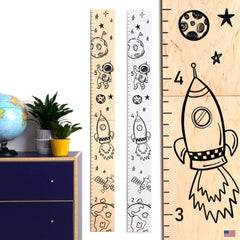
Marks on a door frame get painted over. Pencil lines on a wall disappear when you move. A dedicated growth chart becomes a permanent record that travels with your family. It turns fleeting moments into a keepsake that can be passed down, showing not just how tall your daughter grew, but the home she grew up in. A toddler girl growth chart becomes that permanent record — one that moves with your family and preserves not just how tall she grew, but the home she grew up in.
What to Record Beyond Height
Consider adding the date, age, and a small note on what she was excited about that day, a milestone she reached, or even just the weather. These details add richness to the record, turning numbers into stories.
How to Involve Your Daughter
Let her watch as you measure. Explain what you're doing. As she gets older, she'll enjoy looking back at how much she's grown. The ritual itself becomes part of family tradition, something she'll remember long after she's stopped growing. If she has a brother, a toddler boy growth chart gives him his own dedicated milestone record right alongside hers.

Final Thoughts
The average height of a 4-year-old girl is about 40 inches, but that number only tells part of the story. What really matters is that your daughter is growing steadily along her own curve, supported by good nutrition, adequate sleep, and the love of a family that's paying attention. Height is just one small piece of who she is, and who she's becoming.
At Headwaters Studio, tracking growth is about more than measurements. It's about capturing time, honoring the everyday moments, and creating something beautiful that lasts. Our handcrafted growth charts are made to be part of your home and your family's story, timeless keepsakes that preserve not just how tall your daughter grows, but the life that unfolds along the way. Because childhood is fleeting, but the memories don't have to be.
Frequently Asked Questions About The Average Height Of 4 Year Old Girls
Why does height vary among 4-year-old girls?
Height variation among 4-year-old girls is primarily due to genetics, but also influenced by nutrition, overall health, sleep quality, and sometimes birth weight or prematurity. These factors combine uniquely in each child, creating natural diversity in height that's completely normal.
How can I use a growth chart to monitor my child's development?
Plot your daughter's height measurements on a CDC growth chart at regular intervals, looking for consistent growth along a percentile curve rather than focusing on the specific percentile itself. Consistency matters more than the number; steady growth along any curve indicates healthy development.
Is my 4-year-old girl tall for her age?
If your daughter measures noticeably above the median at age 4, she's likely taller than average, but "tall" is relative. What matters is whether she's growing consistently along her own curve. Tall children with tall parents are simply following their genetic blueprint.
What percentile should my 4-year-old girl be on the growth chart?
There's no "should" when it comes to percentiles. Any percentile within the normal range represents healthy growth. What matters is that your daughter maintains a consistent pattern over time, not which specific line she follows.
Can I predict how tall my 4-year-old girl will be when she grows up?
Rough estimates exist, but they're imprecise. Genetics offers the best clue; looking at parents' and grandparents' heights gives a general range, though individual variation is significant, and multiple factors influence final adult height. In the meantime, a toddler height chart lets you track her actual growth over time; turning each measurement into a data point and a memory worth keeping.
What is considered short stature for a 4-year-old girl?
Short stature is often defined as height below approximately the 3rd percentile, but even measurements below this can be normal if consistent with family genetics. Pediatricians evaluate short stature by considering growth patterns, family history, and overall health, not just a single measurement.