Key Takeaways:
- Every Child Follows Their Own Timeline: Healthy boys at age 6 can range across many percentiles, and percentiles describe position, not potential.
- Growth Is More Than Numbers: Tracking height consistently helps families celebrate development and spot patterns worth discussing with a pediatrician.
- The Right Tools Make Memories Last: A permanent growth chart transforms routine measurements into meaningful family moments you'll treasure for decades.
First grade has a way of making height suddenly matter. Your son lines up with his classmates, and for the first time, you notice, he's one of the taller ones, or maybe one of the shorter ones, and you're not sure what that means. Is he on track? Is the gap between him and his peers normal, or worth a conversation with his pediatrician?
At Headwaters Studio, we've spent years helping families mark these fleeting moments. We understand that tracking height isn't just about numbers, it's about documenting the story of growing up, one pencil mark at a time. As a family-run studio creating heirloom growth charts, we've seen firsthand how meaningful it is to capture these milestones in ways that last beyond childhood.
In this piece, we'll explore what's typical for the average height for a 6-year-old boy's development, how to understand growth charts, what influences height differences, and when to seek guidance from your pediatrician. We'll also share practical ways to track and celebrate your son's growth at home.
Understanding The Average Height For A 6 Year Old Boy
According to the Centers for Disease Control and Prevention (CDC), the average height for a 6-year-old boy in the United States is approximately 45.5 inches, or just under 4 feet tall. This measurement represents the 50th percentile, meaning half of the boys this age are taller, and half are shorter.
But "average" doesn't tell the whole story. Using CDC stature-for-age charts, many healthy 6-year-old boys fall within a range of percentiles, from the lower to the upper bound. A child at the 10th percentile can be just as healthy as one at the 90th percentile. What matters most is that your son is growing consistently along his own curve, not matching someone else's.
What Does "Percentile" Actually Mean?
Percentiles describe where your child falls compared to other children the same age. If your son is in the 60th percentile for height, it means he's taller than 60% of boys his age and shorter than 40%. This isn't a grade or a performance score; it's simply a snapshot of where he stands in relation to his peers at this moment.
Why the Range Is So Wide
Six-year-old boys come in all shapes and sizes, and that diversity is completely normal. Some children are genetically programmed to be taller or shorter. Others may experience growth spurts earlier or later than their classmates. As long as growth is steady and your pediatrician isn't concerned, your son is likely right where he should be.

Average Height For A 6½ Year Old Boy: What's Typical?
By the time your son reaches 6½ years old, you can expect him to have gained about an inch or so in height. The CDC growth-chart reference data are available by month of age, allowing for precise tracking at any age interval.
How Growth Progresses Between Six and Seven
During the early school years, boys typically grow at a steady rate of about 2 to 2.5 inches per year. This is slower than the rapid growth of infancy and toddlerhood, but faster than the plateau that often happens just before puberty. The consistency of this phase makes it easier to track patterns and notice when something might be off.
Half-Birthdays and Growth Tracking
Tracking your son's height every six months gives you a clearer picture of his growth velocity. This regular monitoring helps you celebrate progress and ensures you'll notice early if growth slows or accelerates unexpectedly.
How To Read Growth Charts For Early School-Age Boys
Growth charts can look intimidating at first glance, with curved lines, percentiles, and numbers that seem to shift with every pediatrician visit. But once you understand the basics, they become powerful tools for tracking your son's development over time.
The Basics of CDC Growth Charts
The CDC growth charts are based on U.S. national survey data and provide percentile references for children. These charts plot age on the horizontal axis and height (or weight) on the vertical axis. The curved lines represent different percentiles, showing how children of the same age compare.
For a 6-year-old boy, you'll typically see lines for the 5th, 10th, 25th, 50th, 75th, 90th, and 95th percentiles. Your pediatrician will plot your son's height on the chart at each visit, creating a visual record of his growth trajectory.
What to Look For
The most important thing isn't where your son falls on the chart; it's whether his measurements follow a consistent pattern over time. A child who stays around the 25th percentile year after year is developing normally. A child who suddenly drops from the 75th to the 25th percentile, or jumps from the 10th to the 90th, may need further evaluation.
Why Consistency Matters More Than Position
Pediatricians don't worry if your child is at the 10th percentile; they worry if he was at the 50th percentile last year and the 10th percentile this year without explanation. Growth should follow a predictable curve. Sudden changes in that pattern are what deserve attention. Browsing our full toddler height chart collection helps you find the right format for your home, whether you prefer a classic ruler style or something more personalized to your family's story.

What Drives Height Differences In 6 Year Old Boys?
If you've ever wondered why your son is taller or shorter than his classmates, the answer is a complex mix of genetics, nutrition, sleep, activity, and overall health. No single factor determines height, but together, these elements shape how tall your child will grow.
Genetics plays the Biggest Role
Your son's height potential is largely written into his DNA. If both parents are tall, he's likely to be tall. If both parents are shorter, he'll follow suit. But genetics aren't perfectly predictive; children often fall somewhere between their parents' heights, and occasionally surprise everyone by being taller or shorter than expected.
One rough formula some pediatricians use to estimate adult height is to average both parents' heights, then add 2.5 inches for boys. This isn't a guarantee and has a typical error margin of several inches, but it gives a ballpark idea of where your son might land.
Nutrition Fuels Growth
Proper nutrition provides the building blocks your son's body needs to grow. A balanced diet rich in protein, calcium, vitamins, and minerals supports bone development and overall health. While good nutrition won't override genetics, poor nutrition can prevent a child from reaching their full height potential.
Sleep Is When Growth Happens
Growth hormone release is closely tied to slow-wave (deep) sleep, so adequate, regular sleep supports normal growth. Six-year-olds typically need 9 to 12 hours of sleep per 24 hours. If your son isn't getting enough rest, it could impact his growth over time.
Physical Activity Strengthens Bones
Active play helps build strong bones and muscles, supporting healthy growth and development. While exercise won't make your son taller than his genetics allow, it will ensure his body functions optimally during these critical years.
Health Conditions Can Affect Height
Chronic illnesses, hormonal imbalances, or untreated medical conditions can slow growth. Conditions like growth hormone deficiency, hypothyroidism, or celiac disease may require medical intervention. This is why regular pediatric checkups are so important; they help catch issues early.
How To Track And Celebrate Your Son's Growth At Home
Tracking your son's height at home is about more than measuring inches; it's about creating rituals, celebrating milestones, and preserving memories that matter. The best growth tracking happens when it's woven into the fabric of daily life.
Why Consistent Tracking Matters
Measuring your son's height every few months (or on special occasions like birthdays and holidays) gives you a clear record of his development. It helps you spot patterns, celebrate progress, and create a visual timeline you'll both treasure as he grows.
Create a Ritual Around Measurement Days
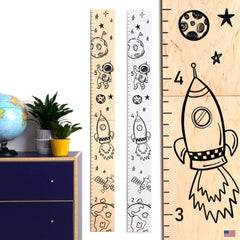
Make tracking height something your son looks forward to. Choose meaningful moments, birthdays, the first day of school, New Year's Day, and turn them into mini-celebrations. Let him stand tall, add his mark, and talk about how much he's grown since last time. These small rituals become the memories that last. A classic growth chart ruler is one of the simplest ways to make measuring feel like a real occasion — mount it once, and it's ready for every birthday, first day of school, and growth spurt worth celebrating.
Invest in a Permanent Growth Chart
Unlike pencil marks on a doorframe that stay behind when you move, a permanent growth chart moves with you. At Headwaters Studio, we craft heirloom-quality growth charts that last generations, are beautiful enough to display in any room, and are meaningful enough to become part of your family's story. Our toddler boy growth chart collection is crafted from premium maple plywood and designed to move with your family, giving every measurement a permanent, beautiful home that no doorframe or painted-over wall ever could. For families tracking a daughter's milestones alongside a son's, our toddler girl growth chart collection makes it easy to find a matching piece so every child has their own lasting record.
Make It Personal
Some families add photos next to each mark. Others write little notes about what their child loved at that age, favorite toys, funny phrases, or milestones reached. These personal touches transform a simple measurement into a rich narrative of childhood.
Celebrate the Journey, Not Just the Numbers
Height is just one part of who your son is becoming. Celebrate his kindness, his curiosity, his sense of humor, and all the ways he's growing, not just physically, but emotionally and intellectually, too. Growth charts should capture the fullness of childhood, not just how tall he's gotten.

Final Thoughts
The average height for a 6-year-old boy is around 45.5 inches, but healthy children come in a wide range of sizes. What matters most isn't where your son falls on a chart; it's that he's growing consistently, thriving, and reaching his full potential in his own time.
Tracking height at home is one of the simplest, most meaningful ways to mark the passage of time. It's a chance to pause, reflect, and celebrate how much has changed since last year, and how much more is still to come. At Headwaters Studio, we're honored to help families preserve these moments. Because childhood is fleeting, but the memories you create together, those last forever.
Frequently Asked Questions About What Is The Average Height Of A 6 Year Old Boy?
Why does my 6-year-old seem shorter or taller than other children their age?
Height differences at this age are usually genetic. If both parents are shorter or taller, your son will likely follow that pattern. Nutrition, sleep, and overall health also play roles, but genetics are the primary driver.
What is considered a normal growth rate for a 6-year-old boy?
Most 6-year-old boys grow about 2 to 2.5 inches per year. As long as your son is growing steadily along his own percentile curve and your pediatrician isn't concerned, his growth rate is likely normal.
How do the average height milestones for a 6-year-old boy compare to those of girls the same age?
On CDC charts, median heights for boys and girls at age 6 are very close; differences are small compared with normal individual variation. Individual variation is much more significant than gender differences at this age.
Should I be concerned if my son is below the 50th percentile on the growth chart?
No. Percentiles describe position, not health. A child at the 10th percentile can be just as healthy as one at the 90th percentile. What matters is consistent growth along his own curve, not where it falls relative to others.
How much should a 6-year-old boy grow in a single year?
Expect about 2 to 2.5 inches of growth per year during the early school years. Some children grow slightly more or less, but this range is typical. If growth stops or accelerates dramatically, talk to your pediatrician.
What are the signs of a growth spurt in 6-year-old boys?
Growth spurts at this age are usually subtle, but you might notice your son suddenly outgrowing clothes, shoes, or seeming hungrier than usual. He may also seem more tired or experience mild leg pain. These are all normal signs of active growth.