Key Takeaways:
- Every Child Grows at Their Own Pace: The average height of a 5-year-old girl serves as a general guideline, but healthy children naturally fall within a wide range of heights.
- Tracking Growth Creates Meaningful Memories: Measuring your daughter's height isn't just about numbers; it's about capturing fleeting moments and watching her story unfold.
- Consistent Growth Matters More Than Comparison: What pediatricians look for is steady progress over time, not whether your child matches a chart's middle line.
She walked into kindergarten orientation last week looking three inches taller than she did at her last checkup, or at least it felt that way. Age five is one of those growth stages that sneaks up on parents fast, and with school entry physicals, new classmates to compare notes with, and a pediatrician asking pointed questions, it's natural to wonder: Is my daughter's height actually where it should be?
At Headwaters Studio, we've spent years alongside parents navigating every stage of childhood growth, helping them track, celebrate, and preserve each milestone with pieces built to last as long as the memories do.
In this piece, we'll explore what the average height of a 5-year-old girl looks like, how to interpret growth charts, what factors influence height, and when variations might warrant a conversation with your pediatrician. Most importantly, we'll talk about how tracking these moments at home becomes part of your family's story.
What Is The Average Height Of A 5 Year Old Girl?
The average height of a 5-year-old girl in the United States typically falls between 42 and 43.5 inches, with the CDC placing the 50th percentile at approximately 43 inches tall. This translates to roughly 3 feet 7 inches. However, this is just a midpoint; healthy girls at this age can measure several inches below or above this number and still fall within what's considered typical growth patterns.
Why Averages Are Just Starting Points
Averages exist to provide context, not to create anxiety. Think of height ranges like shoe sizes; some kids wear a size 11, others wear a size 13, and both are perfectly normal. The average height represents the middle of the bell curve, meaning that roughly half of 5-year-old girls will be shorter than this number, and half will be taller.
What matters far more than a single measurement is the trajectory. Is your daughter growing steadily? Does she generally follow her own curve over time? These questions tell a much more complete story than whether she lands exactly on the 50th percentile line. If you want an easy way to watch that trajectory unfold at home, a toddler height chart lets you capture every milestone in one place rather than relying on scattered notes from checkups.
The Range Is Wide for a Reason
Genetics creates incredible diversity in human height, which is exactly as it should be. A 5-year-old girl might stand 40 inches tall and be on track to reach her family's typical adult height, while another child might measure 45 inches at the same age and also be growing perfectly normally for her genetic blueprint. Both children are healthy; they're just following different maps.

Average Height For A 5½ Year Old Girl: What's Typical?
By the time girls reach 5 and a half years old, you might notice their growth has settled into a steadier rhythm compared to those dramatic toddler years. At this age, the average height is typically between 43 and 44.5 inches, with most girls having gained about an inch since their fifth birthday.
How Much Do Kids Grow Between 5 and 6?
During the year between the ages of 5 and 6, most children grow approximately 2 to 3 inches. This works out to roughly a quarter-inch per month, though growth isn't always evenly distributed. You might see periods where she seems to shoot up overnight, followed by stretches where she stays the same height for weeks.
These growth spurts often coincide with other developmental changes, new skills, increased appetite, or even temporary clumsiness as her body adjusts to its new proportions. It's all part of the beautiful messiness of childhood development.
Why Half-Birthdays Matter for Context
Tracking height at six-month intervals gives you a clearer picture of your daughter's growth pattern than annual measurements alone. It's easier to spot consistent growth (or unexpected plateaus) with more data points. Plus, marking a half-birthday becomes its own small celebration, another excuse to pause and notice how much has changed.
How To Read Growth Charts For Kids Entering School Age
Growth charts can feel intimidating at first glance, with their curved lines and numbered axes. But once you understand what you're looking at, they become useful tools for understanding your daughter's individual growth pattern.
Understanding Percentiles Without Panic
Percentiles show how your child's height compares to other children of the same age and gender. If your daughter is in the 30th percentile for height, it means she's taller than 30% of girls her age and shorter than 70%. Here's what's important: many clinicians consider the 3rd to 97th percentile range on growth charts to be within the usual range.
Being in a lower percentile doesn't mean your child is too short, and being in a higher percentile doesn't mean she's too tall. Pediatricians monitor whether your child maintains a relatively consistent percentile rank over time. A girl who has always tracked along the 25th percentile and continues to do so is growing exactly as she should.
What Your Pediatrician Looks For
Healthcare providers aren't concerned with a single measurement; they're looking at the pattern. Has your daughter's growth remained consistent with her established curve? Is she growing at an appropriate rate for her age? Does her height make sense given her parents' heights?
A sudden drop or spike in percentiles over repeated measurements might prompt questions, but even then, it's often explained by normal variations, measurement errors, or temporary factors like illness. Trust that your pediatrician will flag anything that warrants attention.
The Story Behind the Numbers
Growth charts tell you where your child is in relation to population averages. They don't tell you about her personality, her kindness, her fierce independence, or the way she laughs until she snorts. Those measurements happen at home, in ordinary moments, and they're just as worth tracking as physical height.

What Influences Your 5-Year-Old Girl's Height & Growth Rate?
Height isn't random. It's the result of multiple factors working together, some you can influence and others you can't. Understanding what shapes growth helps you focus your energy where it matters most.
Genetics Set the Blueprint
Your daughter's genetic inheritance from both parents accounts for a substantial portion of her eventual adult height. If both parents are shorter than average, it's likely she will be too. If both are taller, she'll follow suit. When parents differ significantly in height, children typically land somewhere in between, though there's always natural variation.
You can get a rough estimate of potential adult height using the "mid-parental height" formula: add both parents' heights, subtract 2.5 inches (for girls), then divide by two. This isn't a guarantee, just a ballpark that accounts for genetic tendency.
Nutrition Fuels Growth Potential
While genetics provides the blueprint, nutrition supplies the building materials. A diet rich in protein, calcium, vitamin D, healthy fats, and a variety of fruits and vegetables supports optimal bone growth and overall development. That said, most children in the United States get adequate nutrition to reach their genetic height potential.
You don't need to stress about perfect meals every day. What matters is the overall pattern—are proteins, dairy or dairy alternatives, whole grains, and produce regular parts of her diet? If so, you're likely providing what her body needs to grow.
Sleep Is When Growing Happens
Growth hormone is produced by the pituitary gland and secreted in pulses, with major pulses often occurring shortly after sleep onset and in association with slow-wave (deep) sleep, which is why adequate rest is crucial during childhood.
Most 5-year-olds need between 10 and 13 hours of good-quality sleep over a 24-hour period, including a nap. If your daughter regularly gets significantly less than this, it could impact her growth over time, though sleep needs vary by child. Creating consistent bedtime routines and protecting sleep time are among the most valuable ways you can support healthy growth and development.
Physical Activity Supports Bone Health
Active play doesn't make kids taller, but it does strengthen bones, improve coordination, and support overall health. Running, jumping, climbing, dancing, all the natural movements of childhood contribute to strong skeletal development and healthy growth patterns. The goal isn't structured exercise; it's simply making sure your daughter has ample time for active, unstructured play each day.
Normal Variation vs. Concern: When To Talk To Your Pediatrician
Most variations in height are completely normal, reflecting genetic diversity and individual growth patterns. But occasionally, height concerns can indicate underlying issues that benefit from early attention. Knowing the difference brings peace of mind.
Signs of Typical Growth
Your daughter is likely growing normally if she's gaining approximately 2 to 3 inches per year, maintains a relatively consistent percentile on growth charts, appears healthy and energetic, eats reasonably well, and has a height that makes sense given her family background. Even if she's notably shorter or taller than her peers, these factors suggest everything is on track.
When to Raise Questions
Consider talking to your pediatrician if you notice your daughter's growth rate has suddenly slowed significantly, she's dropped more than two percentile curves on growth charts over repeated measurements without explanation, she's much shorter or taller than would be expected based on parents' heights, or she's showing signs of early or delayed puberty alongside height concerns.
Other red flags include signs of nutritional deficiencies, chronic health issues affecting appetite or energy, or if she's expressing significant distress about her height. Even if there's no medical issue, your pediatrician can provide reassurance and guidance.
Trust Your Instincts
You know your daughter better than anyone. If something feels off, if she seems lethargic, isn't eating well, or if her growth just doesn't match what you'd expect, it's always okay to ask questions. Pediatricians would rather answer concerns that turn out to be nothing than miss something that needs attention.
How To Track And Celebrate Your Daughter's Growth At Home
Tracking height at home isn't just about medical monitoring; it's about creating moments. It's about noticing how much has changed, celebrating the person she's becoming, and building rituals that she'll remember long after childhood ends.
Make It a Ritual Worth Remembering
We believe in turning ordinary moments into meaningful ones. Instead of random measurements, create predictable times to mark heights, birthdays, half-birthdays, the first day of school, and New Year's Day. These regular intervals make tracking more consistent and turn the act of measuring into a small ceremony.
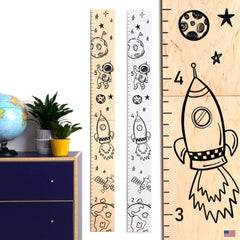
Let her choose stickers or colors for the mark. Take a photo. Write the date and a tiny note about what she loves right now or something funny she said that day. These details transform a simple measurement into a time capsule. A classic growth chart ruler is one of the simplest ways to make measuring feel like a real occasion — mount it once, and it's ready every birthday, half-birthday, or first day of school.
Choose Something That Grows With Your Family
Paper charts taped to door frames get left behind when you move. Walls get painted over. But a portable, beautiful growth chart becomes part of your family's story no matter where life takes you. At Headwaters Studio, we craft growth charts from warp-resistant maple plywood with safe, fade-resistant inks, designed to last through multiple homes and eventually be passed down.
Whether you prefer classic ruler designs or something that reflects your family's personality, browse our toddler girl growth chart collection to find a piece built to move with your family from home to home.
Mark More Than Just Height
Yes, measure her height. But also capture the moments between the marks. How she insisted on wearing her tutu to the measurement. How she stood on tiptoes trying to be taller. How she compared herself to her older brother and declared she'd catch up "really, really soon." We track what matters at Headwaters Studio, and we know it's not just the inches that count. It's the life that happens while growing.
Involve Her in the Process
Let your daughter help with measurements. Teach her to stand straight, heels together, looking forward. Make it interactive and fun rather than clinical. This helps her develop body awareness and turns the ritual into something she looks forward to rather than tolerates.
As she gets older, she might even enjoy comparing milestones with siblings — if you have a son at home, our toddler boy growth chart collection makes it easy to find a matching piece for the whole family.

Final Thoughts
The average height of a 5-year-old girl provides helpful context, but your daughter is more than a number on a chart. She's growing exactly as she should, at her own pace, following her own genetic blueprint, becoming her own person.
These early years pass by in a flash. One day, she's reaching your knee; the next, she's eye-level with the counter. Before you know it, she'll measure herself against you, then surpass you, then move out on her own. But the marks you make now, the simple act of pausing to notice how much she's grown, become anchors in time.
At Headwaters Studio, we create heirlooms because we believe some moments deserve to last forever. Every growth chart we craft is made to travel with your family from home to home, to be cherished for generations, and to serve as a beautiful reminder of these fleeting years. Not just how tall she grew, but the person she became along the way. Mark the moments. Celebrate the inches. Preserve the story.
Frequently Asked Questions: What Is The Average Height Of A 5 Year Old Girl?
What height range is considered normal for a 5 year old?
Many clinicians consider the 3rd to 97th percentiles on CDC growth charts to be within the usual range for 5-year-old girls, which spans several inches below and above the median of approximately 43 inches. Your daughter's specific "normal" depends on her genetic background and individual growth pattern.
How do genetics influence a child's height?
Genetics accounts for a substantial portion of eventual adult height. Children typically grow to heights that make sense based on their parents' heights, though normal variation means they won't always land exactly in the middle.
Does nutrition affect how tall my child grows?
Good nutrition helps children reach their genetic height potential, but it doesn't make them taller than their genetics allow. Most children with access to varied, nutritious food get what they need to grow normally.
Why is physical activity important for childhood development?
Active play strengthens bones, improves coordination, supports a healthy weight, and contributes to overall physical and emotional well-being. It doesn't make children taller but does support optimal development.
How can I monitor my child's growth at home?
Measure height at consistent intervals (birthdays, half-birthdays, or start of school year) using a quality growth chart. Track measurements over time to see your child's individual pattern rather than fixating on single numbers.
When should I be concerned about my child's height?
Consult your pediatrician if your child's growth rate suddenly slows, she drops multiple percentile curves over repeated measurements, her height is significantly different from expected based on family, or you notice other concerning symptoms alongside height issues.